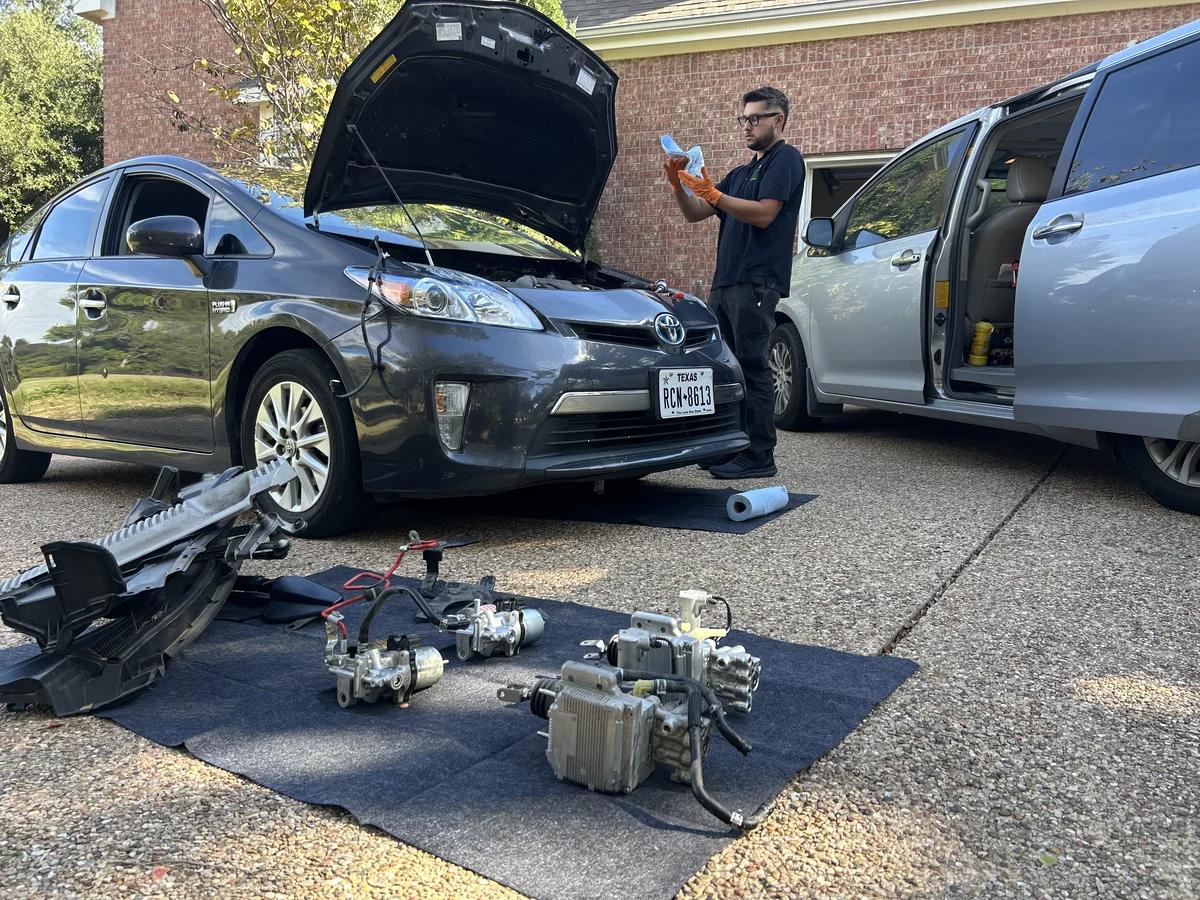
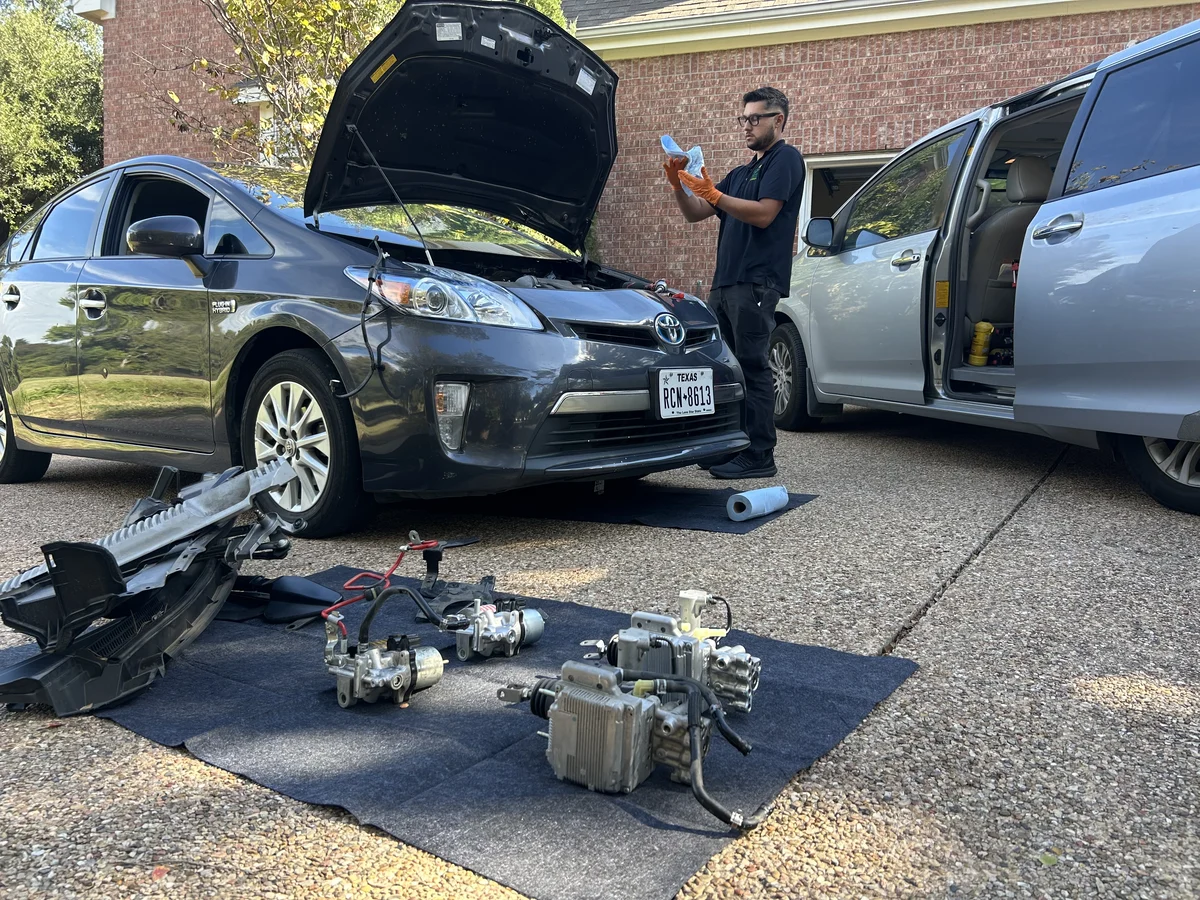
If you drive a Prius and something feels off with the brakes, read this before you drive any farther. The brake actuator is one of the "Big 3" costly repairs on a Prius, and it is the one we'd tell you not to put off. A brake actuator on a Gen 2 (2004-2009) or Gen 3 (2010-2015) Prius usually gives you a few warnings before it quits. Here are the five we hear about most from customers.
What the brake actuator does
The brake actuator is a pump, a pressure tank and a set of valves that send brake fluid to your wheels when you need it. Over time, small leaks let the pressure in the tank drop. The pump then has to run more and more often to keep up, until it can't.
Sign 1: You can hear the pump running
Turn the car on to ready mode with your foot off the brake and listen. In our experience, if you can hear the pump trying to build pressure about every 15 seconds or so, the actuator may be close to failing. Some owners hear it buzz when they open the driver door, before the car is even on. A healthy one stays quiet most of the time.
Sign 2: Warning lights on the dash
Some or all of your brake, ABS and VSC lights come on. Most of our customers tell us the car drove normally when the lights first showed up, so it is easy to shrug off. Don't. The lights mean the system has logged a fault, most often code C1256 or C1391.
Sign 3: A long buzzer that comes and goes
If the warning lights are ignored, a long, persistent buzzer may start. It might stop and come back later. That buzzer is the car telling you to stop driving right now.
Sign 4: The brake pedal feels wrong
The pedal can feel long and soft, or hard and stuck, instead of the normal feel you are used to. Any change in how the pedal feels is worth a scan before you drive on it.
Sign 5: Hybrid battery codes show up too
When a brake actuator code is logged, the car goes into a fail-safe mode that turns off antilock brakes, electronic brake force distribution and regenerative braking. Regen is one of the ways your hybrid battery gets charged, so with it off the battery can end up overly discharged. This is why we often see brake codes sitting next to battery codes.
Before you pay for a new hybrid battery, make sure the brakes are not the real cause. If you have both brake and battery codes, fix the brakes first.
What to do if you see these signs
- Stop driving the car until a full diagnostic is done.
- Have the codes read. C1256 and C1391 are the most common.
- If it is the actuator, plan on replacing it. This is not an easy DIY job.
We no longer recommend used or remanufactured brake actuators. You won't know if a used one works until the long install is finished, and this is one repair where safety matters more than saving money. We only recommend installing a new OEM part.
We come to you. Our Texas based mobile mechanic service can replace the actuator at your home or work. For questions or current pricing call (979) 848-6868.
FAQ
Can I drive my Prius with the brake warning lights on?
No. Stop driving until the car has had a full diagnostic. With the system in fail-safe mode, ABS and regenerative braking are off.
What codes does a bad brake actuator set?
The most common are C1256 and C1391.
Is a used brake actuator okay?
We don't recommend it. We only install new OEM actuators.
Can a bad brake actuator hurt my hybrid battery?
Yes. With regen braking off, the battery can become overly discharged, so brake and battery codes often show up together.
Do you work on Gen 2 and Gen 3?
Yes, and we come to your driveway.
Talk to a technician
Questions about this repair or your hybrid battery? Call or text our technicians.